

Many small business owners compare GPS fleet tracking systems by looking at the monthly subscription alone. It’s an understandable mistake—but it can also become an expensive one.
A system advertised at a low monthly price may require costly hardware, lengthy contracts, installation fees or paid add-ons that significantly increase the total investment. On the other hand, a slightly higher monthly plan might include hardware, software updates, customer support and advanced reporting, making it the better long-term value.
If you’re considering GPS fleet tracking for your business, understanding the true cost of ownership is far more important than focusing on the advertised price. This guide explains what you should expect to pay in the UK, what influences pricing, where hidden costs can appear and how to determine whether the investment will deliver genuine value for your fleet. If you’re still weighing up which type of tracking technology suits your vehicles in the first place, Tracqueur’s guide to how different tracker types work is a useful starting point before you begin requesting quotations.
- Typical GPS fleet tracking costs in the UK
- Monthly subscription and hardware pricing
- Installation and ongoing expenses
- Hidden costs many providers don’t advertise
- How pricing changes with fleet size
- The total cost of ownership explained
- How to estimate return on investment
- Buying tips to help you choose the right system
GPS Fleet Tracking Costs at a Glance
For most UK small businesses, GPS fleet tracking is charged on a per-vehicle, per-month basis. The exact cost depends on the level of functionality, the type of tracking hardware and the contract you choose.
| Cost | Typical UK Range |
|---|---|
| Monthly subscription | £10–£35 per vehicle (basic location-only plans can start nearer £6) |
| GPS hardware | £50–£200 per vehicle (or included in some plans) |
| Professional installation | £0–£100 per vehicle |
| Dashcam add-ons | Additional monthly or hardware cost |
| Annual software cost | Varies by provider and fleet size |
These figures are intended as realistic budgeting estimates. The amount your business ultimately pays depends on your fleet size, required features and the pricing model used by the provider. It’s worth noting that the spread is wide at both ends: stripped-back location-only plans sit below the ranges above, while insurance-approved or camera-equipped systems can comfortably exceed them.
What Determines GPS Fleet Tracking Costs?
Two businesses with the same number of vans can receive completely different quotations. That’s because providers price far more than the tracking device itself.
Fleet Size
Most providers reduce the cost per vehicle as fleets grow. A business with two vans usually pays more per vehicle than a company operating fifty vehicles because larger fleets benefit from volume pricing.
In practice, meaningful discounts tend to appear from around ten vehicles upwards, and they’re rarely advertised on a pricing page. If you’re close to that threshold, it’s worth asking directly—volume pricing is standard practice in the industry, but you generally have to raise it yourself.
Type of Tracking Technology
The hardware you choose has a significant impact on overall cost.
- OBD plug-in devices are usually the cheapest and easiest to install.
- Hardwired trackers cost more but provide greater security and cannot be easily removed.
- Battery-powered asset trackers are designed for trailers, plant machinery and equipment.
- Advanced telematics systems with integrated dashcams typically command the highest prices.
Choosing the right technology depends on how your vehicles are used rather than simply selecting the cheapest option. It’s also worth distinguishing genuine fleet tracking from the low-cost Bluetooth item trackers used for keys, bags and tools. These are inexpensive and useful for small valuables, but they rely on nearby smartphones rather than live cellular connectivity, so they aren’t a substitute for a subscription-based vehicle tracking system.
One further point that rarely appears in pricing discussions: check which mobile network the device uses. UK operators have already retired their 3G networks and have committed to switching off 2G by 2033, which means older 2G-only trackers will eventually stop reporting. Buying a 4G-capable unit today costs little more and avoids paying for the same hardware twice.
Features Included
Basic GPS tracking simply shows where vehicles are located. Premium platforms often include:
- Live vehicle tracking
- Driver behaviour monitoring
- Geofencing alerts
- Route optimisation
- Vehicle diagnostics
- Maintenance reminders
- Fuel usage reporting
- Dashcam integration
Each additional feature can increase the monthly subscription, but not every business needs every capability. A local plumbing company may prioritise dispatch and live tracking, while a nationwide delivery fleet might benefit from advanced reporting and compliance tools.
Contract Length
Contract terms are often overlooked during the buying process.
Many providers offer lower monthly rates in exchange for two or three-year agreements. Others allow rolling monthly contracts, providing greater flexibility but sometimes at a slightly higher monthly price.
If your business is growing quickly or you’re trialling GPS tracking for the first time, contract flexibility may be worth paying for. As a rough rule, it also helps to align the contract term with how long you expect to keep the vehicles—committing to three years of tracking on a van you plan to replace in eighteen months rarely works out well.
Installation Method
Some GPS trackers can be installed in minutes without specialist tools, while others require professional fitting.
Although professional installation increases the initial cost, it can provide a cleaner installation, better tamper resistance and improved long-term reliability—particularly for commercial vehicles operating daily. Where an insurer specifies an approved tracking system, professional fitting is usually a condition of that approval rather than an optional extra.
Support and Software
The monthly fee often covers much more than vehicle tracking.
Many subscriptions also include:
- Software updates
- Cloud data storage
- Mobile applications
- Customer support
- Security improvements
- Reporting dashboards
Understanding exactly what is included helps you compare providers on overall value rather than headline price alone.
GPS Fleet Tracking Pricing Models Explained
Not every provider charges in the same way. Understanding the pricing model makes it much easier to compare quotations accurately.
Monthly Subscription
This is the most common approach. Businesses pay a fixed monthly amount for each tracked vehicle, with access to the provider’s software platform and ongoing support.
It’s predictable, scalable and well suited to growing businesses.
One-Off Purchase
Some providers sell the tracking hardware outright with several years of connectivity included.
Although the upfront investment is higher, long-term ownership costs may be lower if you intend to keep the vehicles for several years. Do check what happens once the included connectivity period ends, as this is the point at which a low-cost purchase can quietly become a recurring expense.
Lease or Rental Model
Instead of purchasing hardware, businesses effectively rent the equipment as part of the monthly subscription.
This keeps initial costs low but usually results in higher overall expenditure over several years. In return, hardware faults and replacements are generally the provider’s responsibility, which has real value for fleets without in-house technical support.
Rolling vs Fixed-Term Contracts
When comparing quotes, always calculate the total amount you’ll pay over the full contract period rather than comparing monthly fees in isolation.
For example, a lower monthly price tied to a three-year agreement could ultimately cost more than a flexible rolling contract if your fleet changes or your requirements evolve.
Hardware Options and How They Affect Cost
The tracking device itself plays a major role in both installation costs and long-term performance.
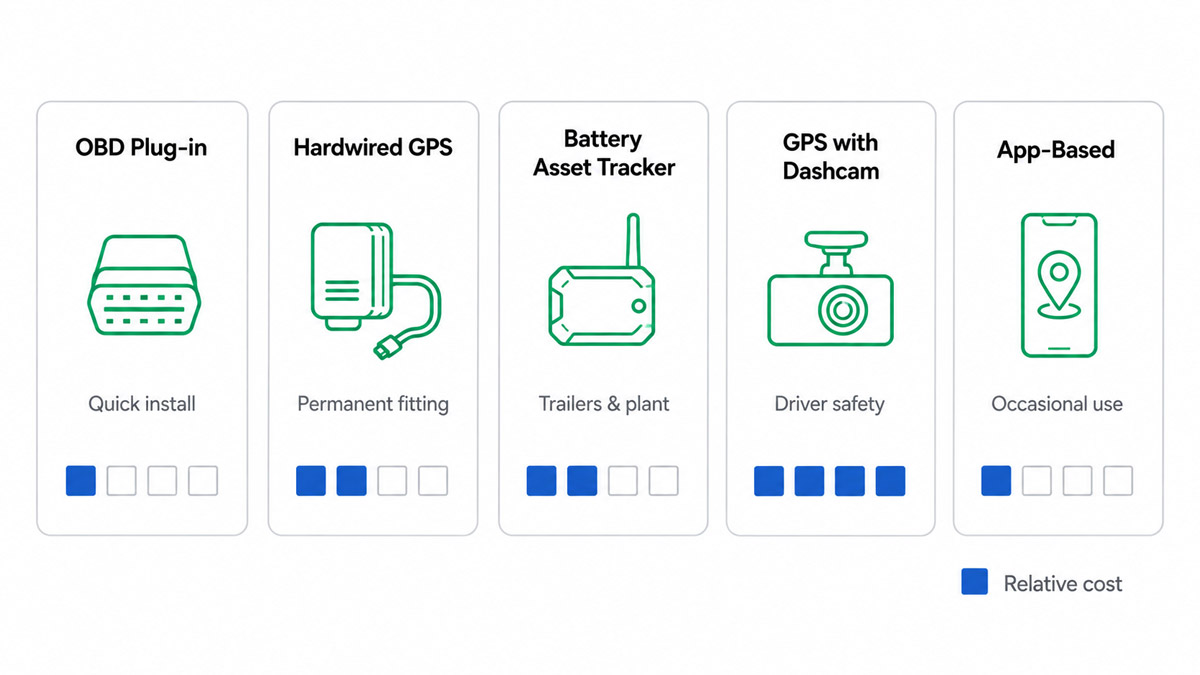
| Tracker Type | Best For | Typical Cost Level |
|---|---|---|
| OBD Plug-in | Small businesses wanting quick installation | Low |
| Hardwired GPS | Permanent fleet installations | Medium |
| Battery Asset Tracker | Trailers and equipment | Medium |
| GPS with Dashcam | Driver safety and incident evidence | Higher |
| App-Based Tracking | Very small fleets and temporary use | Lowest |
Rather than asking which tracker is cheapest, ask which one best suits your business. Paying slightly more for a hardwired device may save money in the long run if your vehicles remain in service for many years, while app-based tracking may be perfectly adequate for businesses with occasional vehicle use.
There’s one category that sits slightly outside this comparison: insurance-approved stolen vehicle recovery trackers, certified by Thatcham Research under its S7 and S5 standards. These are monitored around the clock by a control room rather than managed from your own dashboard, and they carry their own subscription. If your insurer has specified an approved device for a high-value van or specialist vehicle, treat it as a separate line in the budget rather than assuming a standard fleet tracking package will satisfy the policy.
Hidden Costs Most Small Businesses Forget
The advertised monthly fee rarely tells the full story. Before signing any agreement, ask for a complete breakdown of every potential charge.
- Professional installation fees
- Replacement tracking devices
- SIM or mobile data charges
- Software upgrades
- Extra user licences
- Dashcam cloud storage
- API or software integration fees
- Early cancellation charges
- Training or onboarding costs
- Replacing older 2G-only devices as mobile networks are retired
- Removing and refitting trackers when vehicles are sold or replaced
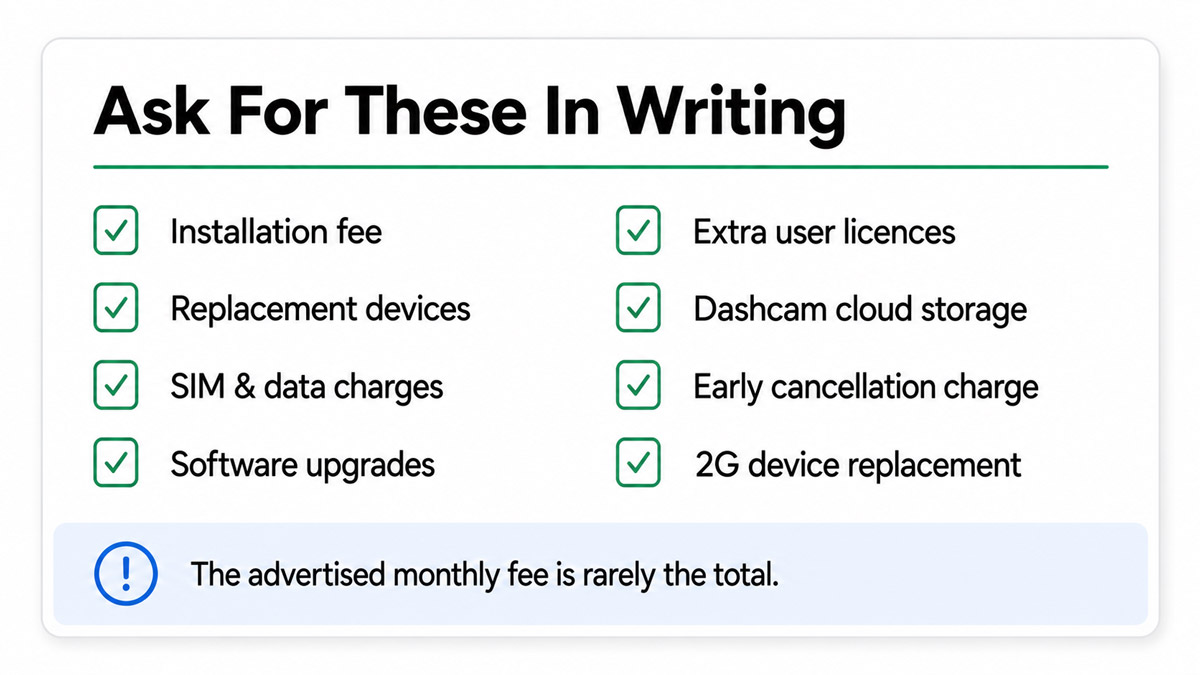
Requesting a written total cost—including setup, subscriptions and optional extras—makes it much easier to compare providers fairly and avoid unexpected expenses later. The last two points on that list catch out more small fleets than any of the others, largely because they only surface years after the original quotation was signed.
Total Cost of Ownership: Looking Beyond the Monthly Fee
One of the biggest mistakes businesses make is judging a tracking system solely by its monthly subscription.
The more useful figure is the total cost of ownership (TCO), which combines every expense over the life of the system rather than focusing on a single invoice.
A simple way to estimate this is:
Total Cost = Hardware + Installation + Monthly Subscription + Optional Add-ons + Future Support or Replacement Costs
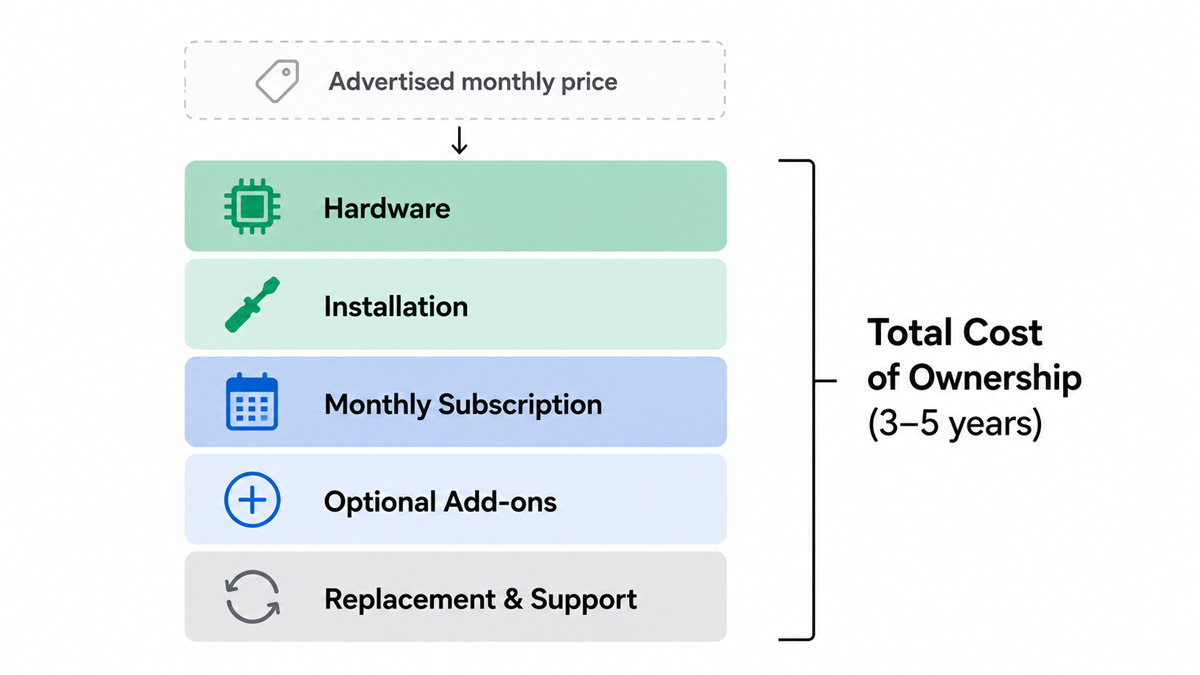
Looking at costs over three to five years provides a much clearer picture of which solution genuinely offers the best value, especially for growing businesses planning to expand their fleet. The exercise is straightforward, and it frequently reverses the ranking: a plan at £8 per vehicle with £180 hardware and a fitting charge can cost more in year one than a £16 all-inclusive plan, even though the headline price suggests the opposite.
Is GPS Fleet Tracking Worth the Cost?
For many small businesses, the real question isn’t how much GPS fleet tracking costs—it’s whether the investment pays for itself.
The answer depends on how your vehicles are used. Businesses that rely on daily deliveries, mobile engineers, tradespeople or service vehicles often recover far more value than the monthly subscription through improved efficiency and better decision-making.
Lower Fuel Costs
Fuel is one of the largest ongoing expenses for most fleets. Even small improvements in route planning and driver behaviour can reduce unnecessary mileage and engine idling.
GPS tracking helps managers identify:
- Excessive idling
- Unnecessary detours
- Poor route planning
- Repeated traffic bottlenecks
- Unauthorised vehicle use
Rather than simply telling you where vehicles are, the data highlights where fuel is being wasted and where operational improvements can be made. Providers commonly point to double-digit percentage fuel savings; in practice, results tend to depend far more on whether anyone actually reviews the reports and acts on them.
Improved Productivity
When managers know which vehicle is closest to the next job, dispatch becomes quicker and more efficient.
Think about the last time an urgent job came in and you rang three drivers in a row simply to work out who was nearest. Instead of making several phone calls to locate available drivers, jobs can be assigned based on real-time locations, reducing delays and helping staff complete more work during the day.
Reduced Vehicle Downtime
Many fleet tracking platforms include mileage reminders and maintenance alerts.
Servicing vehicles at the appropriate intervals helps prevent unexpected breakdowns, extends vehicle life and reduces expensive emergency repairs.
Better Customer Service
Customers increasingly expect accurate arrival times.
Live vehicle tracking enables businesses to provide more reliable ETAs, respond to delays quickly and improve communication throughout the working day.
Greater Security
Vehicle theft remains a concern for many businesses operating vans, trailers and specialist equipment.
GPS tracking improves the chances of locating stolen assets while geofencing alerts notify managers if vehicles leave designated locations outside normal working hours. For tradespeople, the greater exposure is often the tools inside the van rather than the van itself, which is why some fleets pair vehicle tracking with separate asset trackers on high-value equipment.
Example Cost and ROI Scenarios
Every fleet is different, but simple budgeting examples make it easier to understand the potential investment.
| Fleet Size | Estimated Monthly Cost | Typical Buyer |
|---|---|---|
| 2 vehicles | £20–£70 | Local trades business |
| 5 vehicles | £50–£175 | Growing service company |
| 10 vehicles | £100–£350 | Regional fleet |
| 25 vehicles | £250–£875 | Established SME |
These figures represent subscription costs only. Hardware and installation should be added when calculating your overall budget.
Example: Three-Van Electrical Contractor
An electrical contractor operating three vans may initially focus on the monthly subscription. However, reducing unnecessary mileage, preventing one missed appointment each week and improving dispatch efficiency could offset much of the ongoing cost. One recovered callout is often worth more than a month’s tracking across the whole fleet.
The value isn’t created by tracking vehicles—it comes from making better operational decisions using the information collected.
Example: Growing Delivery Fleet
A courier business with ten vehicles may benefit from route optimisation, maintenance reminders and driver behaviour reporting.
Although the monthly subscription is higher, improved scheduling and fewer vehicle disruptions can deliver significantly greater operational value as the fleet expands. At this size, per-vehicle discounts usually become available too, which softens the step up in cost.
Features Worth Paying Extra For
Not every premium feature delivers the same value. Understanding which capabilities genuinely support your business helps prevent overspending.
Usually Worth the Investment
- Live vehicle tracking
- Route history
- Geofencing alerts
- Driver behaviour reporting
- Maintenance reminders
- Mobile apps for managers
Worth Considering for Larger Fleets
- AI dashcams
- Advanced vehicle diagnostics
- Fuel consumption analytics
- Route optimisation
- Custom reporting
- Third-party software integrations
Buying features your business never uses simply increases your monthly costs. Start with your operational challenges rather than the longest feature list. A useful test before adding any extra: name the person who will look at that report, and how often.
How to Compare GPS Fleet Tracking Providers
Price is only one part of the decision.
When comparing providers, evaluate the complete service rather than focusing solely on the lowest monthly quote.
| Factor | Why It Matters |
|---|---|
| Pricing transparency | Helps avoid unexpected charges |
| Contract flexibility | Allows your fleet to grow or change |
| Customer support | Essential if issues arise |
| Ease of installation | Reduces downtime |
| Hardware connectivity | 4G-capable devices avoid early replacement as older networks retire |
| Reporting tools | Supports better business decisions |
| Mobile application | Improves day-to-day usability |
| Scalability | Supports future expansion |
A provider offering slightly higher monthly pricing may represent better long-term value if support, reporting and flexibility are included.
Questions to Ask Before Choosing a Provider
Before signing any agreement, ask these practical questions:
- Is the advertised price the total monthly cost?
- Are hardware and installation included?
- What happens if I cancel early?
- Do I own the tracking hardware?
- Is the device 4G-capable?
- How frequently is vehicle location updated?
- Can the platform grow with my business?
- Are software updates included?
- Is customer support based in the UK?
- Can the system integrate with other software I already use?
These questions often reveal important differences that aren’t obvious from a pricing page alone. If a provider is reluctant to answer any of them in writing, that in itself tells you something useful.
Common Buying Mistakes to Avoid
- Choosing the cheapest subscription without checking total ownership costs.
- Ignoring lengthy contract commitments.
- Buying advanced features that your business is unlikely to use.
- Overlooking installation charges.
- Failing to consider future fleet growth.
- Comparing providers using monthly price instead of overall value.
- Not arranging suitable staff training before implementation.
Taking time to compare complete solutions rather than headline prices usually leads to a better long-term investment.
GPS Fleet Tracking and UK Legal Considerations
Tracking company vehicles is generally permitted, but businesses should ensure employees understand when and why vehicle tracking is used.
A clear written policy helps maintain transparency and explains:
- What information is collected
- Why tracking is required
- Who can access the data
- How long information is retained
- How driver privacy is protected
If vehicles are used outside working hours, discuss whether tracking remains active and ensure your policies reflect your business practices. Where personal use is permitted, a privacy mode that suspends location reporting outside working hours is a sensible feature to ask about at the quotation stage rather than after installation.
Being open about GPS tracking builds trust with employees while helping your business meet its wider data protection responsibilities. Introducing tracking quietly, without explaining it to drivers first, tends to create resistance that no amount of reporting will fix later.
Quick Decision Guide: Which GPS Fleet Tracking System Is Right for Your Business?
The best solution isn’t necessarily the one with the longest feature list—it’s the one that solves your operational challenges without paying for functionality you’ll rarely use.
| If your business… | Consider… |
|---|---|
| Operates 1–3 vehicles locally | Basic GPS tracking with live location and route history |
| Has 4–10 service vehicles | Tracking with driver behaviour reports, maintenance reminders and geofencing |
| Runs a growing regional fleet | Advanced telematics with reporting, integrations and fleet analytics |
| Manages high-value vehicles or equipment | Hardwired GPS trackers with theft alerts and optional dashcams |
| Needs evidence for incidents or insurance claims | GPS tracking combined with AI-enabled dashcam technology |
If you’re purchasing your first tracking system, focus on reliability, ease of use and transparent pricing. Additional features can often be added later as your business grows.
Frequently Asked Questions
How much does GPS fleet tracking cost per vehicle in the UK?
Most UK businesses can expect to pay between £10 and £35 per vehicle per month, depending on the level of tracking, reporting and telematics features included. Entry-level, location-only plans can start lower, while camera-based or insurance-approved systems sit above this range. Hardware and installation costs may be charged separately or bundled into the subscription.
Is GPS fleet tracking worth it for a small business?
Yes, particularly if your business relies on mobile staff, deliveries or field service vehicles. Better route planning, improved dispatch, reduced downtime and increased visibility often provide value that extends well beyond the monthly subscription.
Can GPS tracking reduce insurance premiums?
Some insurers may offer more favourable terms for businesses using vehicle tracking or driver monitoring systems. Where a discount or policy condition is involved, insurers generally specify a Thatcham-approved system—typically category S7 or the higher S5, which adds automatic driver recognition—rather than a standard fleet tracking device. Any potential savings will depend on your insurer, vehicle type, claims history and the technology installed.
Can I install GPS trackers myself?
Some devices, particularly OBD plug-in trackers, are designed for simple self-installation. Hardwired systems generally require professional fitting to ensure reliable operation and greater protection against tampering. Insurance-approved trackers almost always require certified installation for the approval to remain valid.
Do I need a long-term contract?
Not always. Many providers offer rolling monthly agreements alongside fixed-term contracts. Before committing, compare the total cost over the contract period rather than looking only at the monthly fee.
What are the biggest hidden costs?
Potential additional costs include installation, replacement hardware, software upgrades, extra user licences, cloud storage, integration fees and early termination charges. Ageing 2G-only hardware is worth checking too, as those devices will need replacing before the network is retired. Always request a complete written quotation before signing an agreement.
How long does it take to see a return on investment?
Every business is different, but many companies begin seeing operational improvements soon after implementation as dispatch becomes more efficient, unnecessary mileage is reduced and vehicle utilisation becomes easier to monitor.
Can GPS tracking help with vehicle maintenance?
Yes. Many platforms monitor mileage and vehicle usage, allowing businesses to schedule servicing at the appropriate time instead of relying on manual records. Preventative maintenance can reduce unexpected breakdowns and extend vehicle life.
Is it legal to track company vehicles in the UK?
Businesses should ensure vehicle tracking is implemented transparently and that employees understand how tracking data is collected, used and protected. Clear internal policies help maintain trust and support responsible data management.
Conclusion
GPS fleet tracking is no longer a tool reserved for large logistics companies. Affordable systems now make it accessible to tradespeople, delivery businesses, service engineers and growing SMEs across the UK.
The key is to look beyond the advertised monthly subscription. Hardware, installation, contract length, support and optional features all contribute to the real cost of ownership. Comparing providers on headline price alone can result in paying more over the lifetime of the system.
Instead, focus on the value the platform brings to your business. A solution that improves vehicle utilisation, supports better dispatching, reduces unnecessary mileage and provides clearer operational insight can deliver benefits that extend well beyond cost savings.
Before making a decision, compare quotations carefully, calculate the total investment over several years and choose a provider whose pricing, support and functionality align with both your current needs and your future growth plans. If there’s one thing worth taking from this guide, it’s that the cheapest quotation is almost never the cheapest system. The right GPS fleet tracking system isn’t simply another business expense—used properly, it becomes an operational tool that helps your business work smarter every day.