

A GPS tracker can show a pin that looks exact, but that pin is rarely accurate to the last metre. Most consumer devices place themselves within a few metres outdoors in good conditions. Buildings, trees, poor satellite visibility, hardware quality and delayed updates all change what you see on screen.
Accuracy is not a single number. A tracker can calculate a good position and still report it late, lose satellite lock for a moment, or show a shifted location because of its surroundings. Once you can tell those situations apart, GPS data becomes far easier to interpret.
How Accurate Are GPS Trackers in Real-World Conditions?
Most consumer GPS trackers deliver roughly 3 to 10 metres of accuracy outdoors with a clear view of the sky. For tracking a vehicle, pet, child, suitcase or piece of equipment, that is usually enough. A pin sitting several metres from the device does not mean the tracker is faulty.
What a few metres of error actually looks like
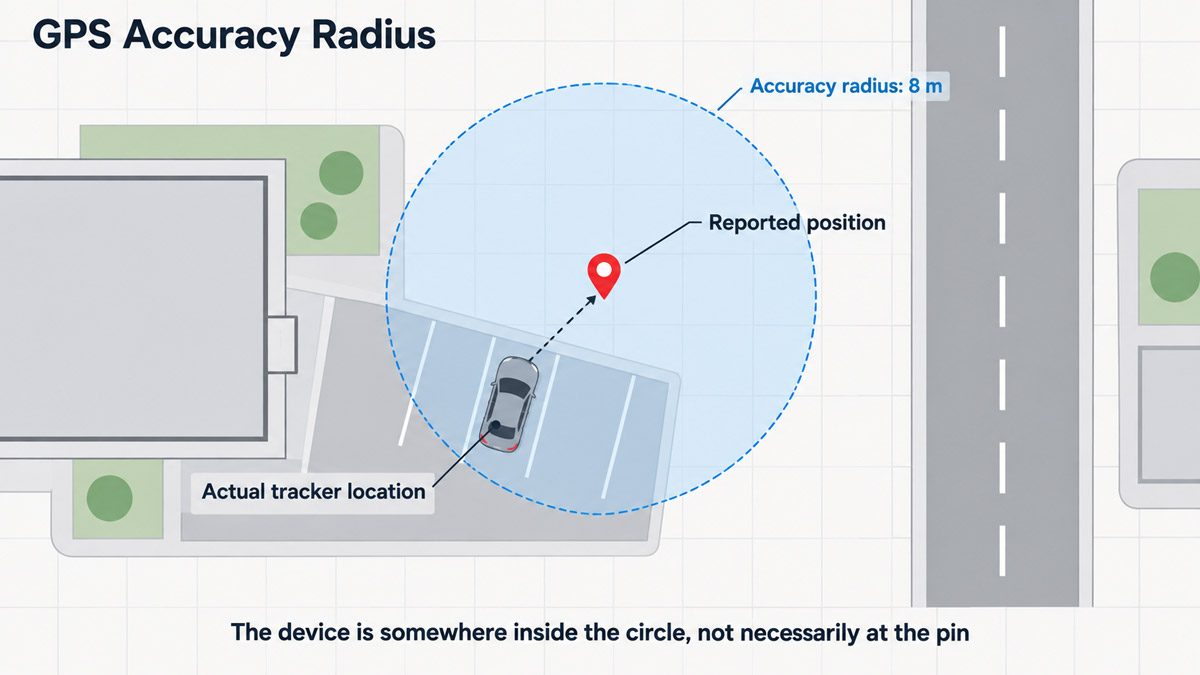
Picture a tracker in a car parked outside an office. The app may place it several metres from the vehicle, which is normal uncertainty. That gap only matters when you need to identify a specific parking bay, entrance or side of a building. Many apps help by drawing an accuracy circle around the pin: the device is somewhere inside that radius, not necessarily at its centre. A wide circle is the app telling you the fix is weak.
What GPS Accuracy Actually Means
Accuracy describes how close the reported position is to the device’s true position. It matters, but it is only one part of tracking performance.
Accuracy vs precision
Accuracy is closeness to the true location. Precision is consistency between repeated measurements. A tracker can report almost the same point every time and still be a few metres off: consistent, but not correct.
Accuracy vs update frequency
Update frequency tells you how often a tracker sends a new fix, not how close each fix is. A device reporting every few seconds draws a smoother trail without being any more accurate than one reporting every minute.
Accuracy vs what the app displays
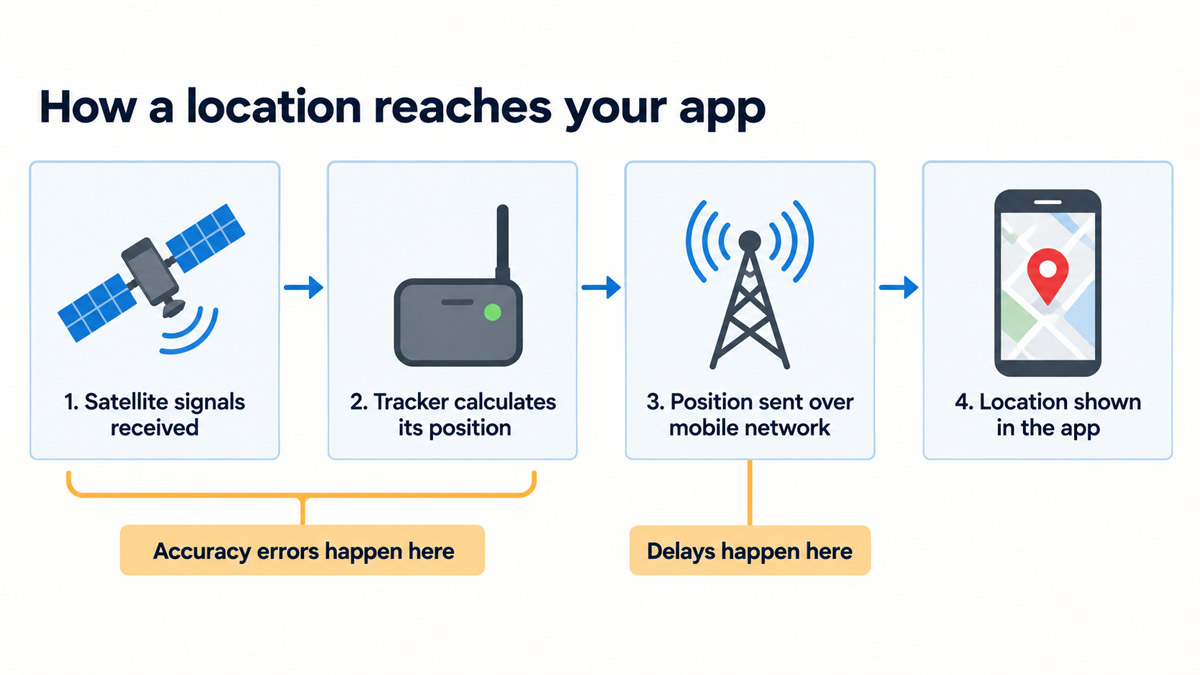
A tracker works out its position from satellite signals, then transmits it to a server, usually over a mobile network. An apparently wrong location is often simply an old one. Positioning and data delivery fail for different reasons, which is why the connection method a tracker uses matters as much as its receiver.
What Makes GPS Trackers Less Accurate?
GPS works best when the receiver can see several well-spread satellites. Anything that blocks, reflects or weakens those signals adds error.
Buildings, tunnels and trees
Tall buildings, dense woodland and tunnels all cut satellite visibility. City centres are hardest, because glass, concrete and steel both block and bounce signals.
Multipath interference
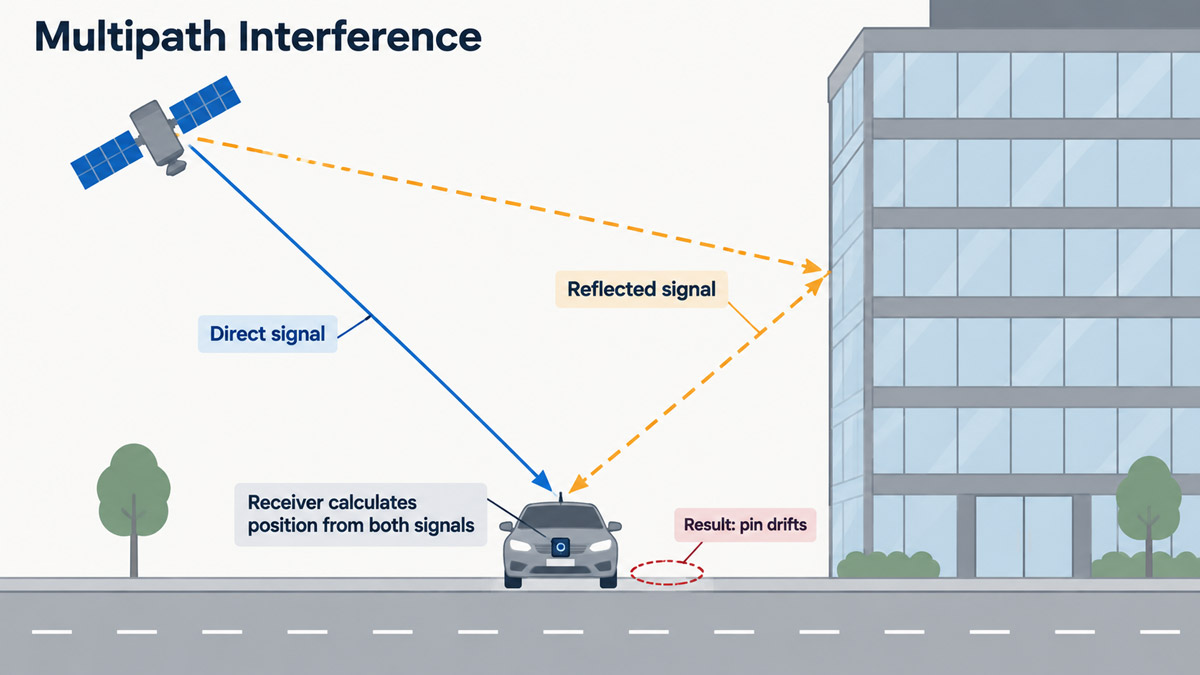
A signal can reflect off a building before reaching the receiver, which then calculates a position from a mix of direct and reflected signals. This is multipath interference, and it appears as a drifting pin, sudden jumps, or a position that wanders while the tracker sits still. It is the most common reason a tracker looks unreliable in a city.
Satellite geometry
Satellite count matters, but so does spread. Satellites scattered across the sky give a much better fix than the same number bunched in one direction. Receivers call this dilution of precision, and it explains why accuracy at one fixed location can vary from hour to hour.
Atmospheric effects
Signals slow slightly as they cross the ionosphere and troposphere, introducing small errors. Weather is often blamed when tracking goes wrong, but rain and cloud matter far less than obstructions, reflections and satellite geometry.
Receiver hardware
Accuracy also depends on the chipset, antenna and signal processing inside the device. Two features separate strong hardware from budget units: support for multiple constellations (GPS, Galileo, GLONASS, BeiDou), and dual-frequency reception, which compares two signals from the same satellite and rejects reflections far more effectively.
Cold starts
A receiver that has been switched off, or moved a long way while dormant, needs anything from seconds to a couple of minutes to find satellites again. Early fixes in that window are often the least accurate, so treat a tracker’s first reported position after a long sleep with caution.
Placement
Where the device sits matters as much as what is inside it. A tracker buried under metal or sealed in a shielded compartment will underperform one with a clear view of the sky. For vehicles, choosing an installation point that balances concealment against signal strength makes a measurable difference.
GPS Tracker Accuracy in Different Environments
| Environment | What to expect |
|---|---|
| Open outdoor area | Strongest and most consistent performance |
| Dense city | Reflection, blockage and location drift are common |
| Forest or mountainous terrain | Reduced satellite visibility increases uncertainty |
| Indoors | Signals are often weak or unreliable |
| Tunnels and underground car parks | Satellite positioning may be unavailable |
In difficult environments, many devices fall back on cellular or Wi-Fi positioning to keep a usable estimate alive. That helps, but these are approximations, sometimes accurate only to tens or hundreds of metres, and should not be read as a satellite fix.
GPS Tracker vs Smartphone: Which Is More Accurate?
There is no rule that a dedicated tracker beats a phone. Performance depends on the receiver, antenna, supported constellations, software and environment. Flagship smartphones often carry excellent dual-frequency hardware, while a dedicated tracker is optimised for one job, such as surviving on a vehicle for months. The useful question is not “phone or tracker?” but which device has the positioning and connectivity the job requires.
When a Tracker Shows the Wrong Location
A location that looks wrong can have several different causes.
- Positioning error: the receiver calculated a point several metres from the true position.
- Stale data: no recent update has arrived, so the app is showing an older position.
- Signal loss: the device temporarily cannot obtain a reliable fix.
- Transmission delay: the tracker knows where it is, but weak coverage delays delivery.
- Map interpretation: the pin does not always make the real distance obvious.
This matters most in vehicle and fleet work, where a precise position that is sixty seconds old can be less useful than a rougher one from five seconds ago. Update intervals deserve as much attention as hardware when comparing fleet tracking systems.
How Accurate Do You Actually Need Your Tracker to Be?
You rarely need the most precise device available. The right level of accuracy depends on the task.
Pets and personal belongings
Knowing the general area and direction of travel usually matters more than metre-level precision. For items that stay close to home, short-range Bluetooth finders such as AirTag, Tile and SmartTag often solve the problem more neatly than satellite tracking.
Vehicles and theft recovery
Metre-level positioning earns its keep here, because narrowing a search to one street or yard is often the difference between recovery and a write-off.
Fleet and delivery operations
Fleets need more than a precise point. Dependable update intervals, accurate timestamps and stable connectivity shape routing, driver visibility and arrival estimates.
Surveying and precision work
Construction, surveying and agriculture demand tighter tolerances. Differential GPS and Real-Time Kinematic positioning reach sub-metre or centimetre results under suitable conditions.
Can You Improve GPS Tracker Accuracy?
You cannot remove every source of error, but the controllable factors are worth addressing.
- Give the device a clearer view of the sky and avoid unnecessary shielding from metal or enclosed compartments.
- Choose capable hardware. Multi-constellation and dual-frequency support make the biggest difference in built-up areas.
- Check connectivity. Weak mobile coverage makes a tracker look unreliable even when its positioning is fine.
- Keep firmware current and the installation sound. Both prevent avoidable faults.
- Use correction systems only when needed. DGPS, SBAS and RTK suit work where metre-level positioning is genuinely insufficient.
Standard GPS vs High-Precision GPS
| Positioning type | Typical use | Precision level |
|---|---|---|
| Consumer GPS/GNSS | Vehicles, pets, people and assets | Generally metre-level |
| Augmented or corrected positioning | Specialist navigation | Can reach sub-metre |
| RTK | Surveying, agriculture, construction | Can reach centimetre-level |
Higher precision brings extra equipment, correction data and cost. Centimetre accuracy is impressive, but almost nobody tracking a van or a dog needs it.
How to Tell Whether Your Tracker Is Performing Normally
If a device regularly seems inaccurate, test it before assuming it is defective.
- Test it outdoors in the open and compare the reported position with the real one.
- Repeat the test where the problem usually occurs.
- Check whether you are seeing a bad fix or simply an old update.
- Review the installation point for obstruction.
- Check mobile coverage and the configured update interval.
A tracker that behaves outdoors but drifts in a car park or city centre is being limited by its environment, not its hardware.
Frequently Asked Questions
How accurate are GPS trackers normally?
Most consumer trackers achieve metre-level accuracy outdoors in favourable conditions, commonly around 3 to 10 metres. Results vary by device and environment.
Can a GPS tracker be wrong by several metres?
Yes, and it often is. Several metres of error is normal when satellite visibility is reduced or signals are reflected by nearby structures.
How accurate are GPS trackers indoors?
Considerably worse, because building materials weaken or block satellite signals. Some trackers supplement GPS with cellular or Wi-Fi positioning.
Do GPS trackers work without internet?
A receiver can calculate its position from satellite signals alone. Sending that position to an app in real time normally requires a cellular or other data connection.
Which type of GPS tracker is the most accurate?
For everyday use, look for a multi-constellation receiver, ideally dual-frequency, with a decent antenna and reliable connectivity. RTK systems are far more precise but built for specialist work.
Conclusion
The most useful answer to “how accurate are GPS trackers?” is not a single figure. Metre-level accuracy is realistic outdoors in good conditions, while buildings, tunnels, hardware, satellite geometry and connectivity all shape what the app finally shows.
Judge a tracker on the full picture: how close the position is, how often it updates, how reliably it reports, and how it behaves where you will actually use it. A dependable metre-level device beats centimetre precision you will never need.