

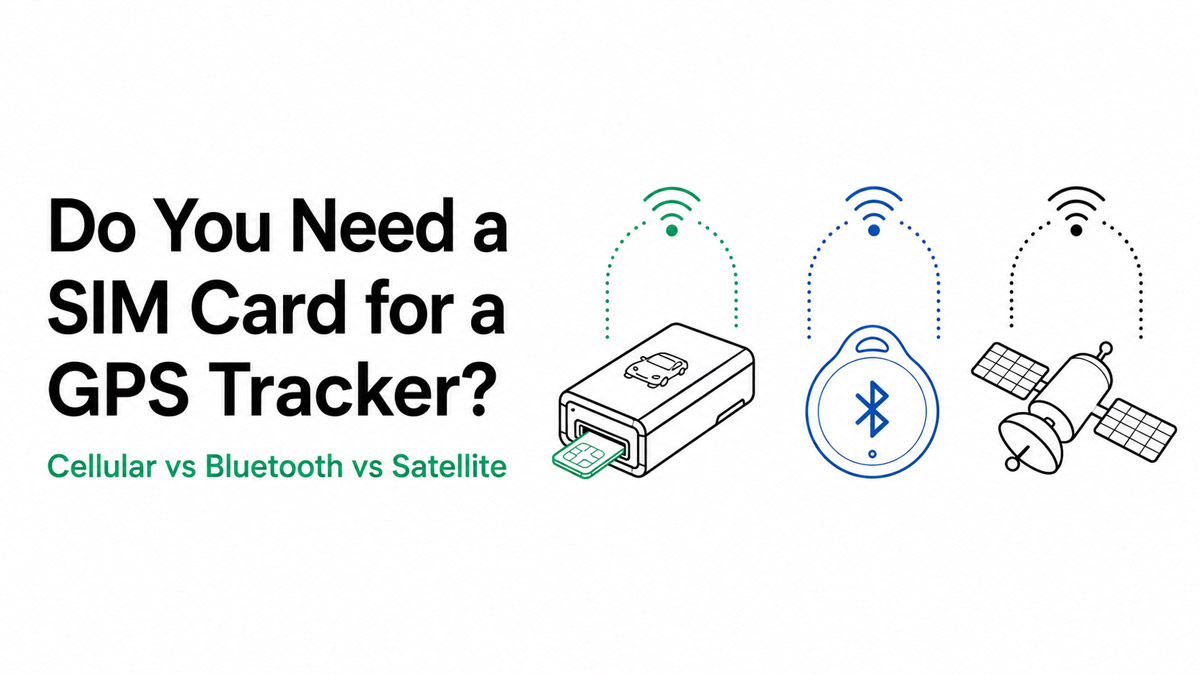
Many people assume a GPS tracker needs a SIM card to know where it is. In reality, that’s only half the story. A GPS tracker can work out its location without any SIM card at all—but if you want to see that location on your phone in real time, a SIM card (or another communication method) usually becomes essential.
This distinction causes a lot of confusion, especially when comparing GPS vehicle trackers with Bluetooth tags such as AirTags or specialist satellite trackers. It’s one of the most common questions we hear at Tracqueur, and the answer nearly always comes down to the same thing: what you expect the tracker to do once it knows where it is. While all three technologies help locate people or belongings, they work in very different ways and are designed for very different situations.
This guide explains exactly when a SIM card is required, how each tracking technology works, and which option makes the most sense for your needs.
- Understand why GPS and SIM cards perform different jobs.
- Learn the difference between Cellular, Bluetooth and Satellite trackers.
- Find out when a SIM card is essential—and when it isn’t.
- Compare costs, coverage, battery life and tracking capabilities.
- Discover which tracker suits cars, pets, luggage, keys and outdoor adventures.
- Avoid common buying mistakes before choosing a tracker.
Do You Actually Need a SIM Card for a GPS Tracker?
The short answer is usually yes if you want live tracking.
A GPS receiver can calculate its location using satellites without any internet connection or mobile signal. However, knowing its position isn’t very useful unless it can send that information somewhere.
That’s where a SIM card comes in. It connects the tracker to a mobile network, allowing it to transmit location updates to an app or web portal.
If you only need to record journeys for later review or locate nearby items, a SIM card may not be necessary. For vehicle security, theft recovery and fleet management, however, real-time communication is usually essential. Think of it in practical terms: if a van goes missing at 3am, a location stored quietly inside the device is worthless. A location sitting on your phone screen is what actually gets it recovered.
GPS vs SIM Card – They Do Completely Different Jobs
The biggest misconception is thinking GPS and a SIM card do the same thing. They don’t.
| Technology | Job |
|---|---|
| GPS | Calculates the device’s location using satellites. |
| SIM Card | Sends that location through a mobile network. |
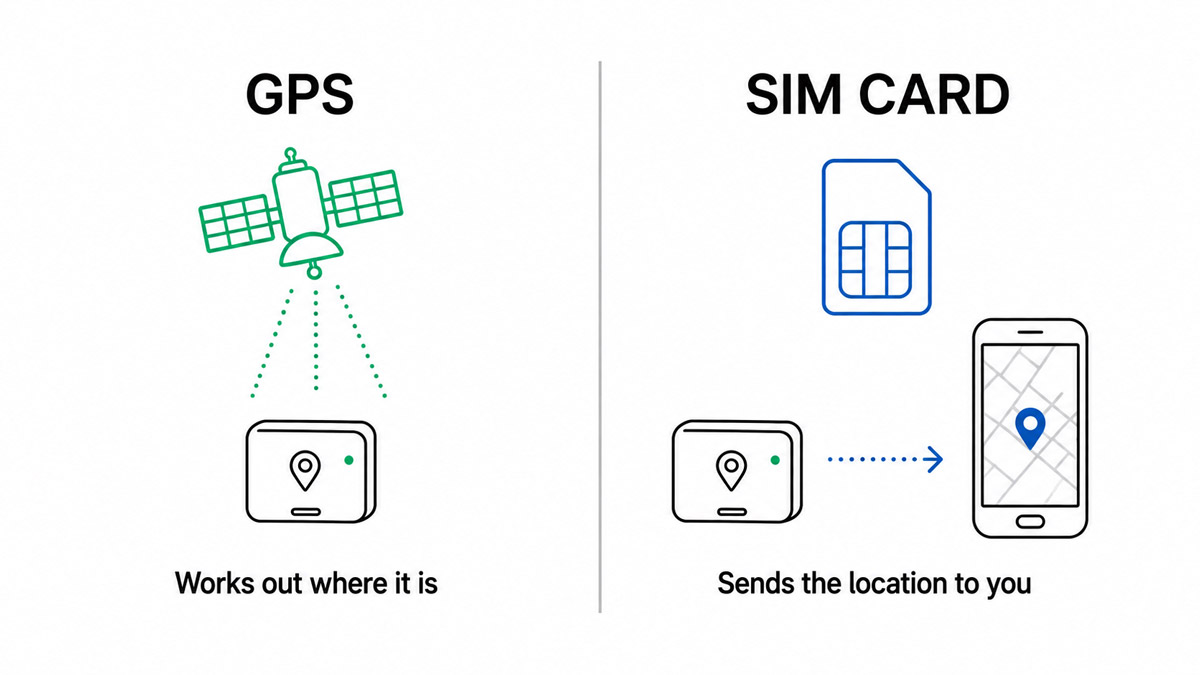
An easy way to think about it is this:
- GPS is the eyes. It sees where the tracker is.
- The SIM card is the voice. It tells you where the tracker is.
Without GPS, the tracker doesn’t know its position. Without a SIM card, it knows its position but cannot share it in real time. That distinction matters more than most product listings let on—plenty of “no subscription” devices are simply trackers that never speak.
How a GPS Tracker Works
- The GPS receiver listens to signals from navigation satellites.
- The tracker calculates its precise location.
- The SIM card connects to a mobile network.
- The location is uploaded to a secure server.
- Your mobile app displays the latest position on a map.
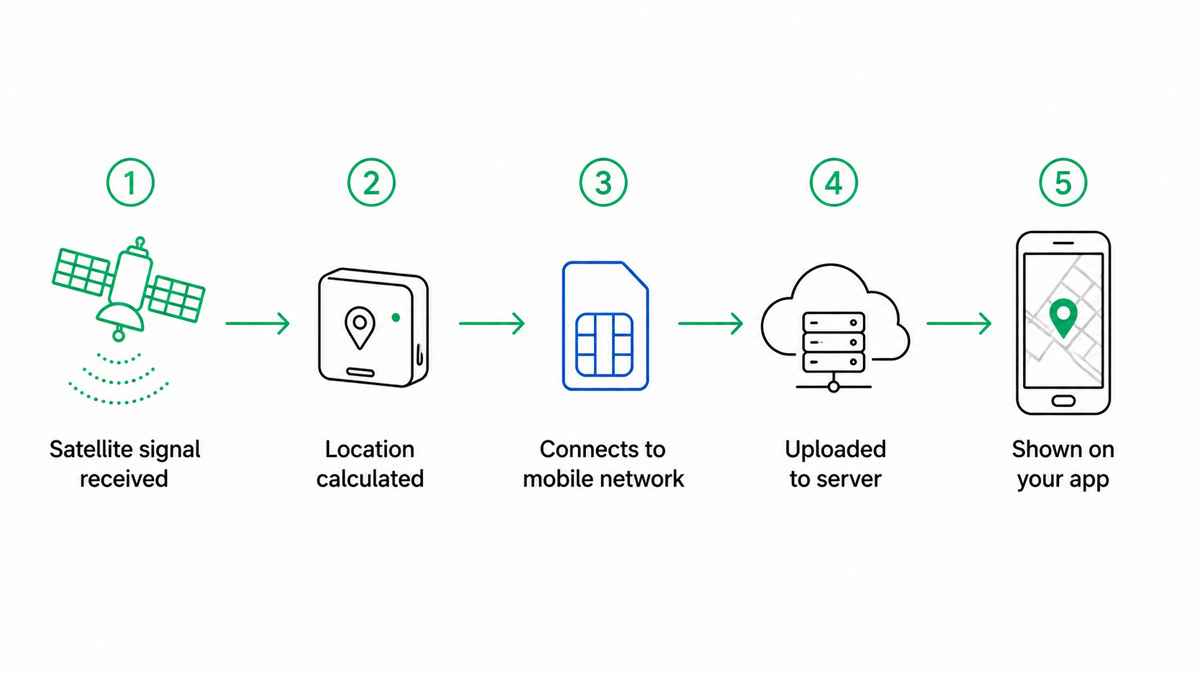
This process typically takes only a few seconds, allowing modern trackers to provide near real-time updates. How often it repeats is worth checking before you buy. Most devices report frequently while moving and far less often while parked, which is precisely how they balance responsiveness against battery life—and why two trackers with identical hardware can behave very differently in daily use.
Cellular vs Bluetooth vs Satellite Trackers
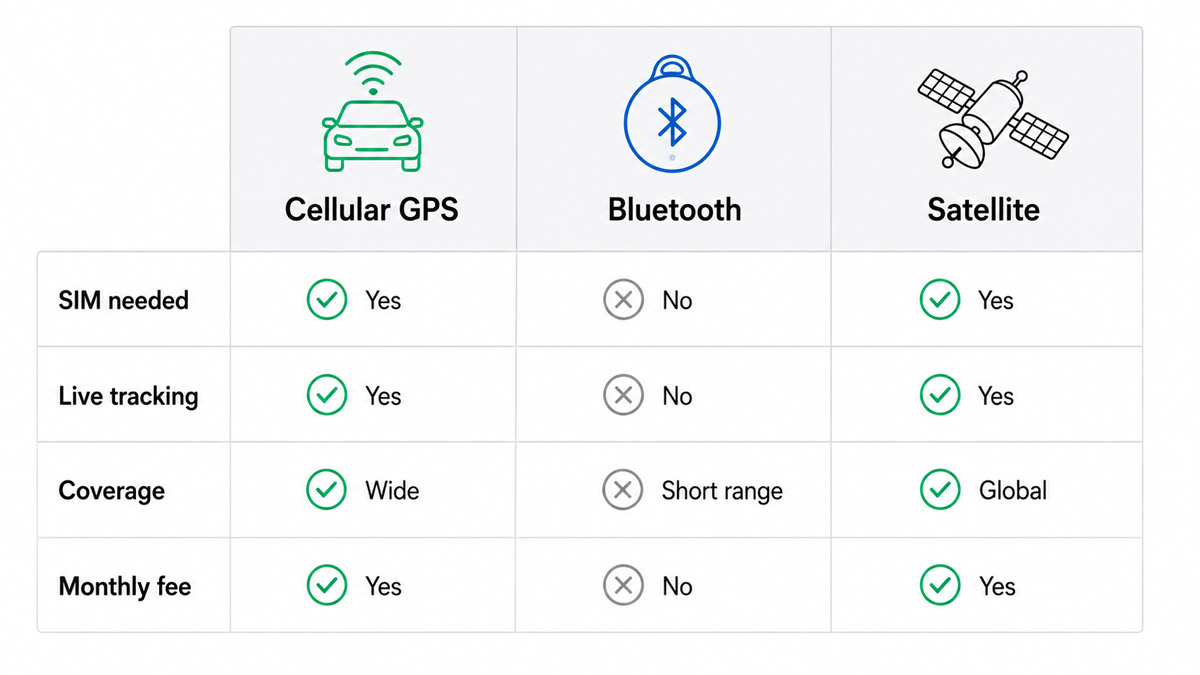
| Feature | Cellular GPS | Bluetooth | Satellite |
|---|---|---|---|
| Needs SIM | Yes | No | No mobile SIM |
| Live Tracking | Yes | No | Yes |
| Coverage | Where mobile signal exists | Short range | Worldwide |
| Monthly Fee | Usually | No | Usually |
| Battery Life | Moderate | Excellent | Lower |
| Best For | Vehicles & assets | Keys & wallets | Remote expeditions |
Cellular GPS Trackers
These are the most common vehicle tracking devices. They use GPS to determine location and a SIM card to send updates over mobile networks.
They support features such as live tracking, geofencing, movement alerts and theft recovery, making them ideal for cars, motorcycles, caravans and business fleets. Geofencing in particular tends to be the feature owners end up relying on most, because an alert the moment a vehicle leaves the driveway is far more useful than a map you have to remember to check.
Bluetooth Trackers
Bluetooth trackers are designed for nearby belongings rather than long-distance tracking.
Instead of communicating with satellites or mobile networks, they connect to nearby smartphones. Modern tags extend that range through crowd-finding networks, where any compatible passing phone can anonymously report a tag’s position—useful in a busy city centre, unreliable on a quiet country lane. If you’re weighing up the main options, our comparison of AirTag, Tile and Samsung SmartTag covers how those networks differ in practice.
This makes them excellent for locating misplaced keys or luggage but unsuitable for tracking a stolen vehicle across the country. Plenty of people have learned this the hard way: a tag pings once, hours later, because someone happened to walk past with the right phone in their pocket—by which point the trail is cold.
Satellite Trackers
Satellite trackers communicate directly with communication satellites rather than mobile phone networks.
They continue working where there is no mobile coverage, making them popular for offshore sailing, mountain expeditions and remote field work. The trade-off is significantly higher hardware and subscription costs.
The line here is starting to blur, too. Direct-to-mobile satellite services have begun arriving in the UK, allowing standard handsets and some connected devices to exchange basic messages via satellite when they drift out of terrestrial coverage. It isn’t a replacement for a dedicated satellite communicator yet, but it does mean the gaps in the map are slowly shrinking.
Which Tracker Is Right for Different Situations?
| Situation | Recommended Technology |
|---|---|
| Car security | Cellular GPS |
| Motorcycle protection | Cellular GPS |
| Caravan tracking | Cellular GPS |
| Fleet management | Cellular GPS |
| Dogs and pets | Cellular GPS |
| Lost keys | Bluetooth |
| Wallet or handbag | Bluetooth |
| Remote hiking | Satellite |
| Ocean travel | Satellite |
Pets are the clearest illustration of why the technology has to match the scenario. A Bluetooth tag on a collar tells you almost nothing once a dog is out of range and running, which is why a cellular pet tracker—paired with a clear plan for what to do if your dog goes missing—makes a far bigger difference than the tag alone.
Choosing the right tracker depends less on the technology itself and more on where you intend to use it and how quickly you need location updates.
Can a GPS Tracker Work Without a SIM Card?
Yes—but there are important limitations.
GPS Data Loggers
These devices record locations internally instead of transmitting them. You must retrieve the tracker later to view the journey, which makes them well suited to mileage records, driver training or route analysis, and entirely unsuitable for security.
Bluetooth Item Trackers
Bluetooth devices rely on nearby phones rather than mobile networks. They work well in busy areas but become much less reliable in isolated locations.
Satellite Communicators
These provide live tracking without using traditional mobile networks, although they generally require specialist satellite subscriptions.
What Happens If Mobile Signal Is Lost?
Many people assume tracking immediately stops.
In reality, the GPS receiver usually continues calculating location even when there is no mobile coverage.
The difference is that those positions cannot be transmitted until the tracker reconnects. Some professional devices temporarily store the journey and upload it once a signal returns, so you end up with a complete route rather than a gap—a detail worth confirming on any device you’re considering, because cheaper units often simply lose the data.
Trackers fitted with roaming SIMs can also switch between UK mobile networks, helping reduce coverage gaps while travelling.
UK Network Considerations
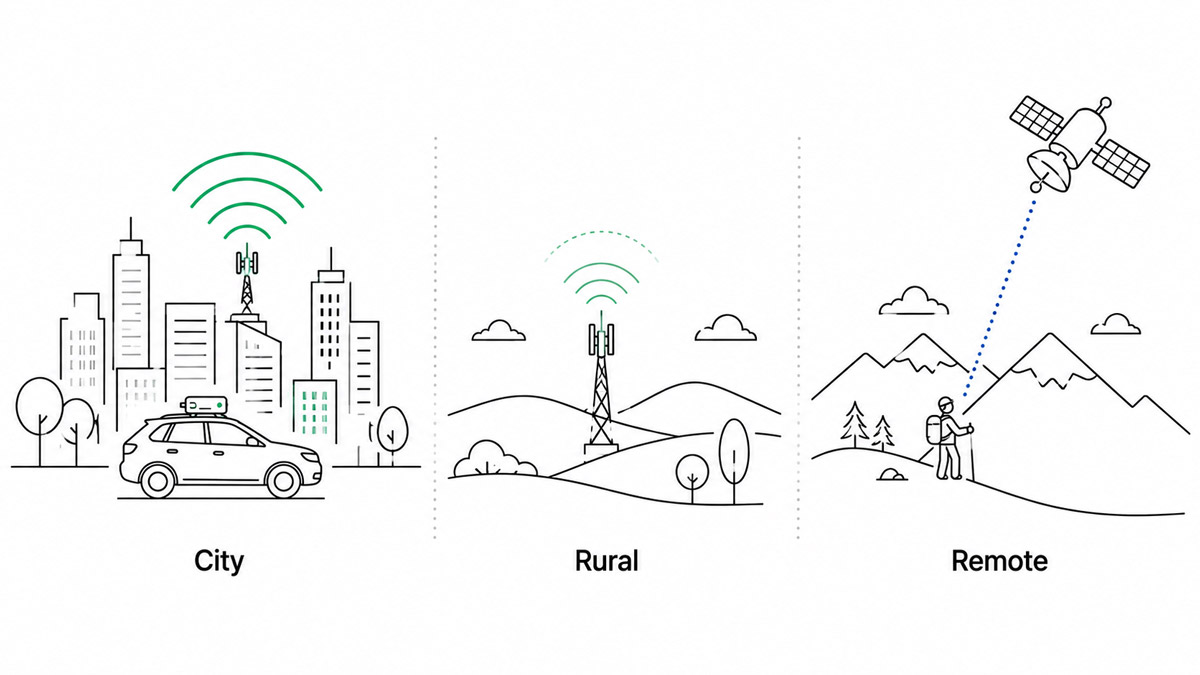
For most vehicle owners, mobile coverage is rarely a problem in towns and cities. Rural locations can be more challenging, and stone buildings, underground car parks and shipping containers all weaken signal further.
Professional GPS trackers often use roaming SIMs that automatically connect to the strongest available network rather than relying on a single provider. In practice, this is one of the clearest dividing lines between a budget tracker and a serious one.
Network generation matters too. The UK’s mobile operators have now completed their 3G switch-offs, and 2G is scheduled to follow later this decade, so a tracker that depends on legacy networks is effectively on borrowed time. If you’re buying a new device, check that it supports 4G connectivity—ideally the low-power 4G standards designed for connected devices, which tend to hold a signal better at the edges of coverage.
Do GPS Trackers Need a Monthly Subscription?
Many do, but not all.
A subscription typically covers:
- Mobile data usage.
- Tracking platform access.
- Cloud storage.
- Software updates.
- Security monitoring services.
Bluetooth trackers usually avoid these costs because they don’t use mobile data. Satellite trackers generally have the highest ongoing fees due to satellite communication services.
The figure that actually matters is the total cost over two or three years, not the price on the box. For businesses running several vehicles that gap widens quickly, as our breakdown of GPS fleet tracking costs sets out in more detail.
Common Myths About GPS Trackers
Myth: GPS needs the internet
GPS receives signals directly from satellites and does not rely on internet access.
Myth: A SIM card helps GPS find your location
The SIM doesn’t determine location—it only transmits it.
Myth: Bluetooth trackers are GPS trackers
Bluetooth trackers and GPS trackers solve different problems. One is designed for nearby belongings, while the other is intended for wider-area tracking.
Myth: Every tracker has monthly fees
Many Bluetooth trackers have no ongoing subscription. Costs depend on how the device communicates.
Common Buying Mistakes
- Buying a Bluetooth tracker for vehicle theft protection.
- Ignoring subscription costs before purchasing.
- Choosing outdated mobile technology.
- Assuming all trackers work equally well in remote locations.
- Overlooking consent and privacy obligations when tracking a vehicle, employee or person rather than your own property.
- Focusing only on purchase price instead of long-term reliability.
How to Choose the Right GPS Tracker
If you need live tracking, theft recovery or fleet management, choose a cellular GPS tracker with reliable mobile connectivity.
If you simply want help finding misplaced everyday items, a Bluetooth tracker is usually the simplest and most affordable solution.
If your activities regularly take you beyond mobile coverage—such as mountaineering, offshore sailing or remote expeditions—a satellite tracker offers the greatest reliability despite its higher cost.
The best tracker isn’t the one with the most features. It’s the one designed for the environment where you’ll actually use it.
Frequently Asked Questions
Does GPS work without a SIM card?
Yes. GPS can determine location without a SIM card, but it usually cannot share that location in real time.
Can I use my own SIM card in a GPS tracker?
Some trackers allow this, while others use built-in or embedded SIMs managed by the manufacturer. Embedded SIMs are generally less flexible, but they remove the guesswork around data plans and network compatibility.
Do GPS trackers work abroad?
Generally yes, provided the SIM includes international roaming and the device supports the local networks. It’s worth confirming both before travelling, as coverage and charges vary considerably by country.
Are Bluetooth trackers better than GPS trackers?
Neither is universally better. Bluetooth trackers are ideal for nearby personal items, while GPS trackers are designed for wider-area tracking and security.
Do satellite trackers need mobile coverage?
No. They communicate directly with satellite networks, making them suitable for remote areas where mobile signals are unavailable.
Conclusion
So, do you need a SIM card for a GPS tracker? If your goal is real-time tracking, vehicle security or remote monitoring, the answer is almost always yes. The SIM card doesn’t help the tracker find its location—it enables that location to reach you.
Bluetooth trackers remain an excellent choice for everyday belongings, while satellite devices are unmatched in remote environments. Understanding these differences makes it far easier to choose the right technology without paying for features you don’t need—or missing the ones you do.
Before buying any tracker, start by asking a simple question: What am I trying to protect, and where will it be used? Answer that honestly and the decision usually makes itself. Get it wrong, and you’ll be looking at a perfectly functional device that simply can’t tell you the one thing you needed to know.